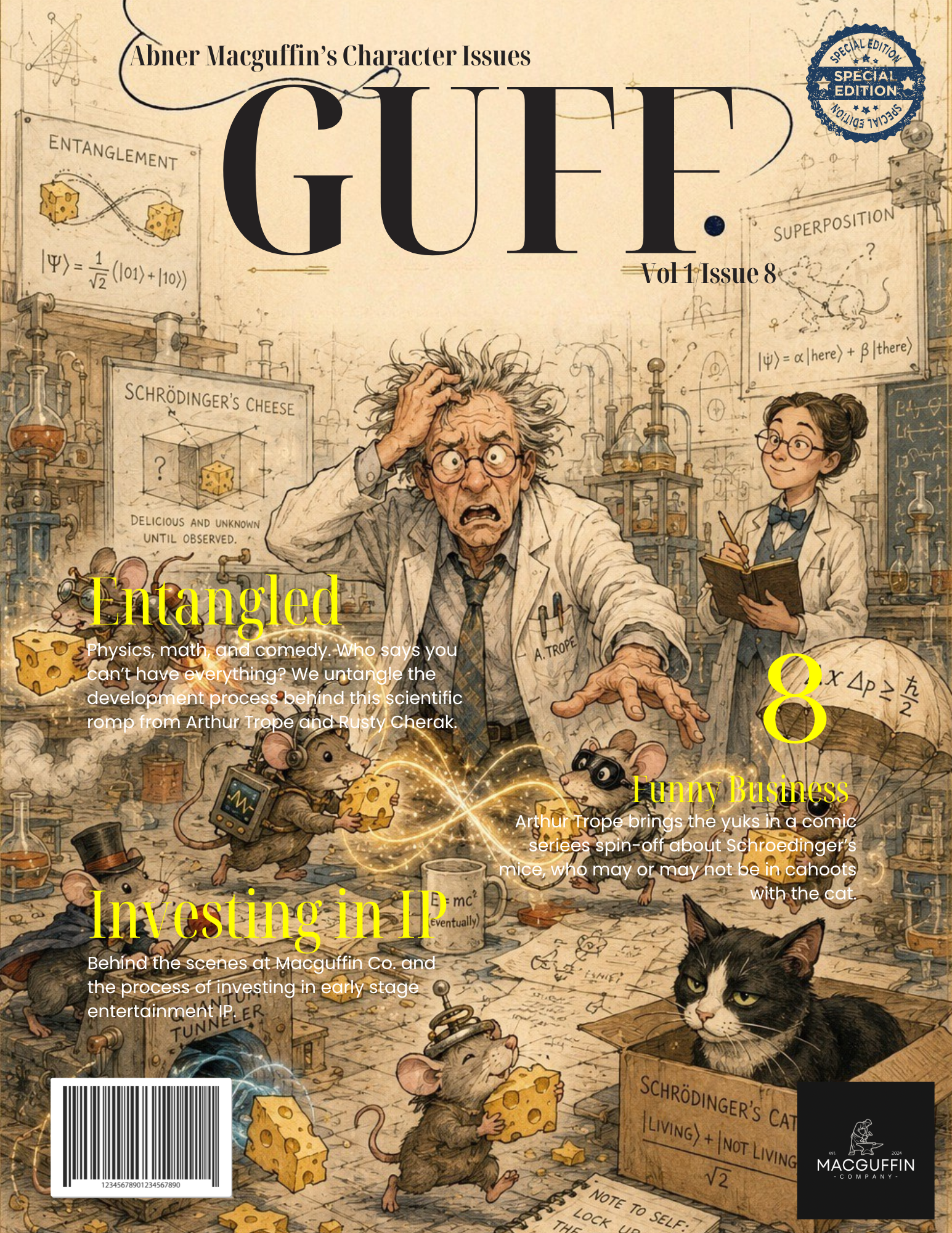
Guff 8: Schrödinger’s Mice
“Schrödinger’s cat may or may not be dead. And Schrödinger’s mice may or may not have something to do with it.”
Concept of the Week
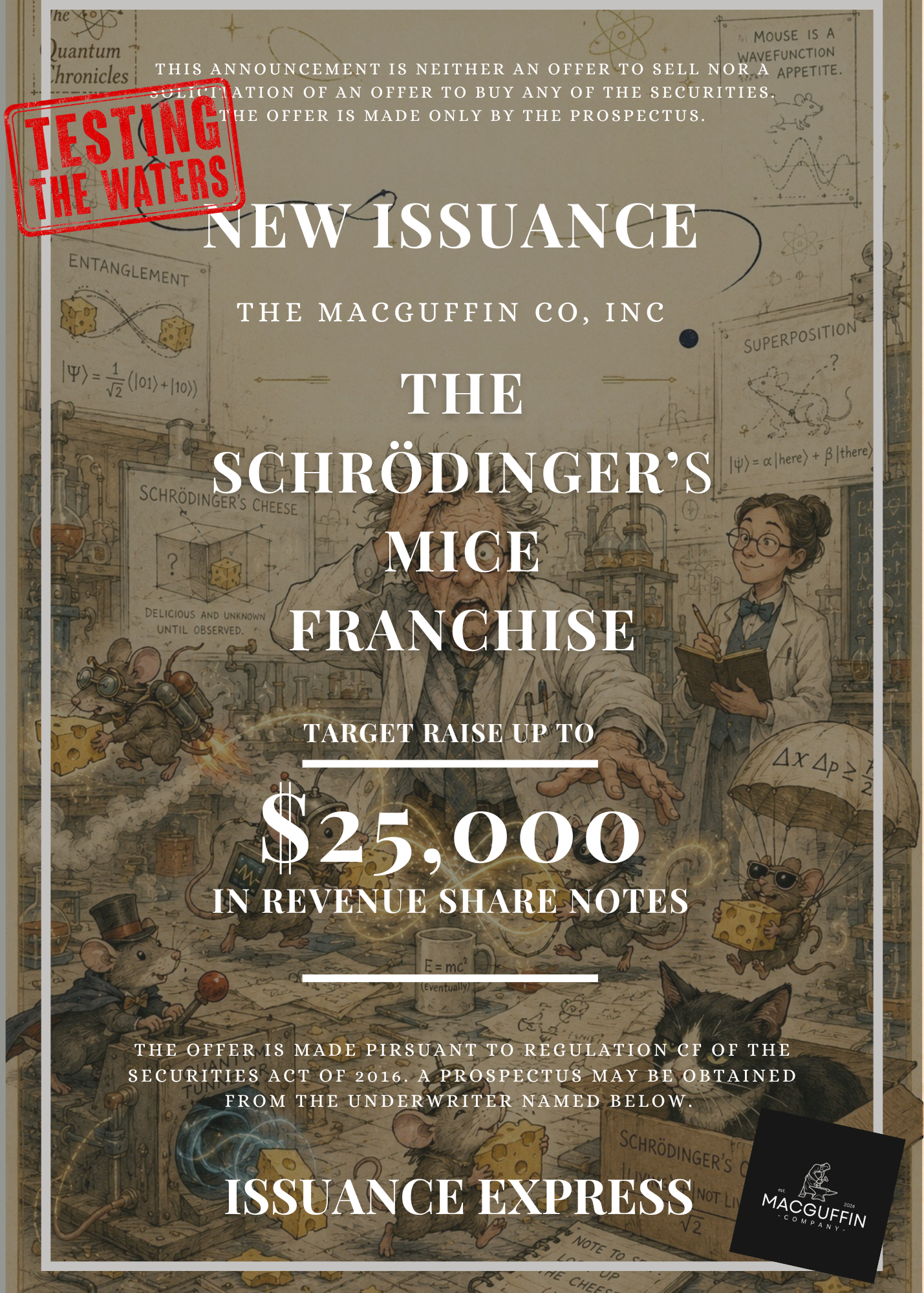
There are, broadly speaking, two kinds of laboratory mice. There are the ones who run through mazes, press little levers, and contribute quietly to the advancement of human knowledge. And then there are ours.
We are pleased to introduce Schrödinger’s Mice, a new science-comedy franchise in development at Macguffin Co. The premise is straightforward enough: a colony of lab mice has figured out how to break the laws of physics. There is one catch.
They can only do it when nobody is looking.
The moment a human being—or a camera—observes them, they become perfectly ordinary mice again. No teleporting. No quantum tunneling. No appearing simultaneously on both sides of a locked cheese vault. Just innocent little rodents sitting there wondering why everyone is yelling.
We have named this the Observation Rule, mostly because “The Thing That Makes Trope Slowly Lose His Mind” was harder to fit on the style guide.
And that single rule is the engine underneath the whole property.
Meet Dr. Arthur Trope. He has a problem.
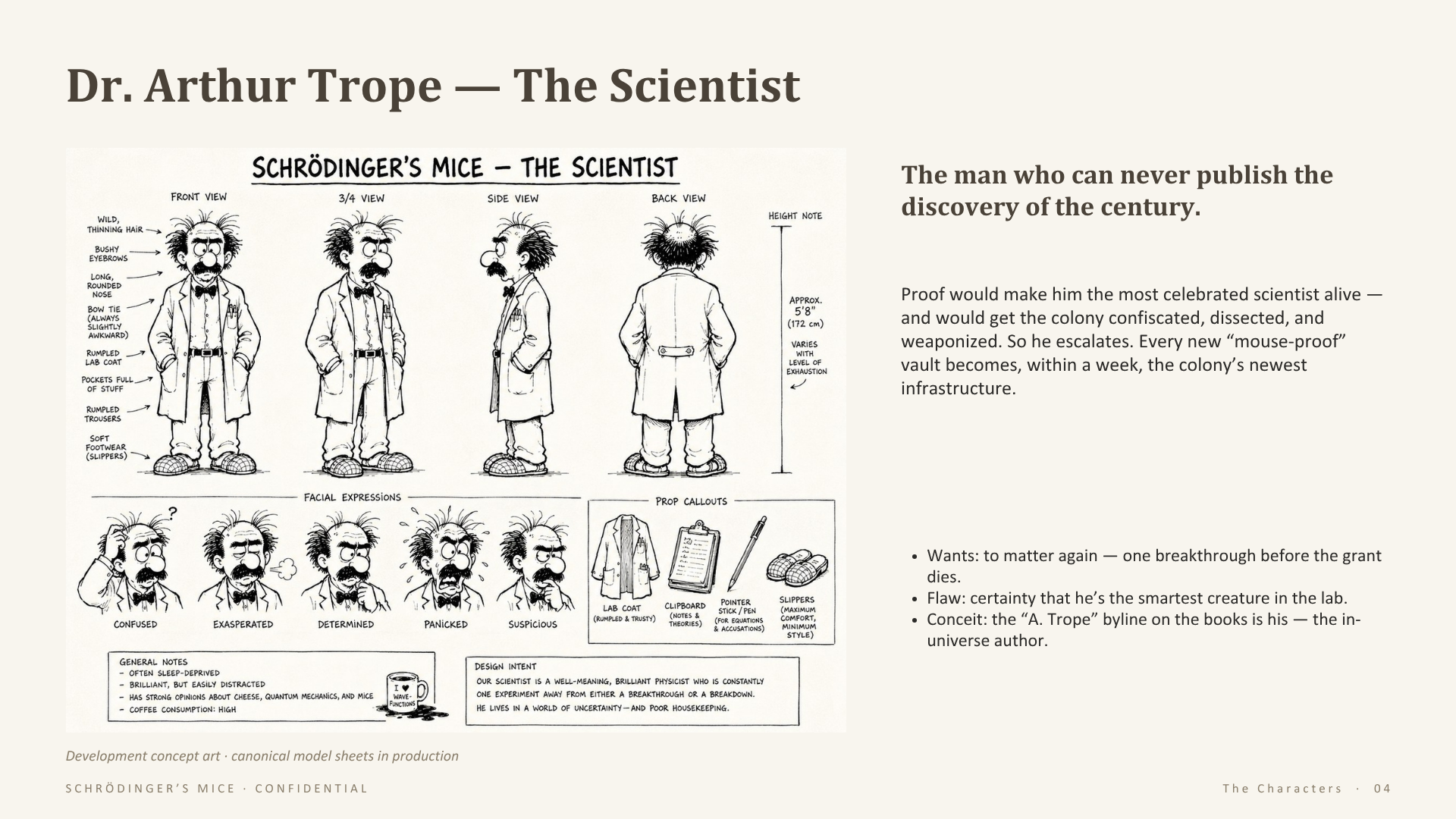
Dr. Arthur Trope was famous once—briefly, and for the wrong experiment. Now he operates a cluttered university laboratory on its last grant, where sealed cheese keeps disappearing and mice have developed the annoying habit of turning up on the wrong side of walls.
Trope eventually reaches the only logical conclusion available to a physicist in these circumstances: the mice are violating the laws of nature.
Unfortunately, proving this would require observing them.
Which immediately causes them to stop doing it.
So Trope possesses what may be the greatest scientific discovery in history and absolutely no publishable evidence that it exists. Worse, if he ever did prove it, the mice would likely become specimens, weapons, or both. His solution, naturally, is not to leave well enough alone. His solution is to build increasingly elaborate mouse-proof systems, each of which the mice eventually repurpose as infrastructure.
Scientists call this escalation.
The mice call it free equipment.
Fortunately, somebody in the lab is competent.
That would be Emmy, Trope’s new lab assistant.
Emmy is the first human to understand what is actually happening, precisely because she learns not to look directly at it. She begins deciphering the colony’s squeak-notation, negotiating cheese-for-peace arrangements, and functioning as an unofficial diplomatic service between two civilizations that increasingly regard each other as unreasonable.
Then there is the Cat.
The Cat is calm, silent, and apparently unconcerned with the accepted behavior of space, time, matter, or cats. More importantly, it is the only observer whose gaze does not collapse the mice’s abilities—which makes it simultaneously their natural predator, existential nightmare, and possibly something stranger.
Emmy thinks it is basically a normal cat.
This may be the least scientific statement anyone in the laboratory has made.
The mice themselves are becoming organized.
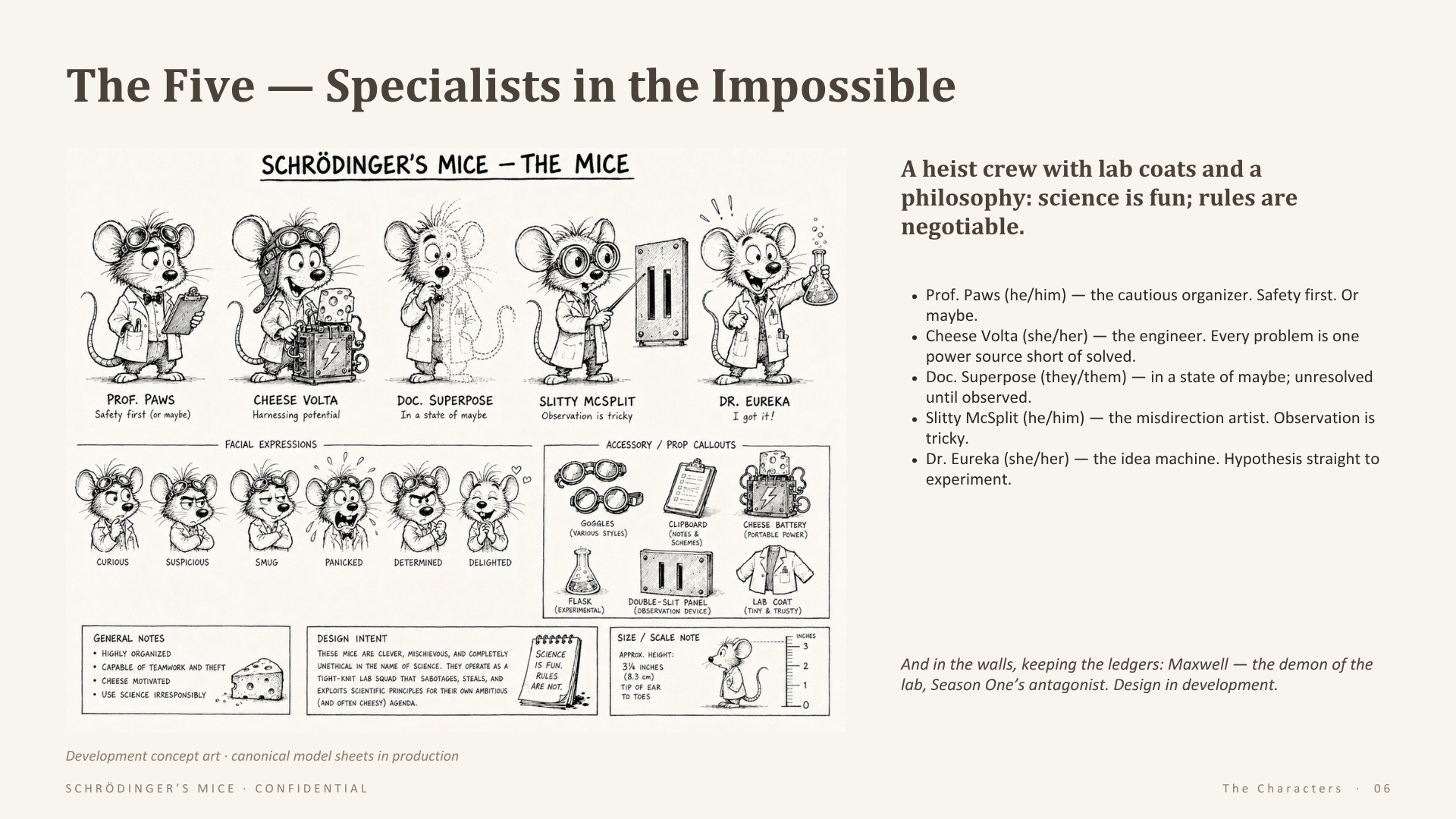
At the center of the colony are five specialists in the impossible: cautious Prof. Paws; engineer Cheese Volta; ambiguously located Doc. Superpose; misdirection expert Slitty McSplit; and the relentlessly experimental Dr. Eureka.
And somewhere deeper in the walls is Maxwell, the colony’s patient bookkeeper and emerging revolutionary, who has decided that spending one’s life hiding from observers is undignified and is working on a device designed to make the colony—and eventually everything else—permanently unobservable.
We see no potential downside to this.
Fifty jokes, ten shorts, one increasingly unstable universe.
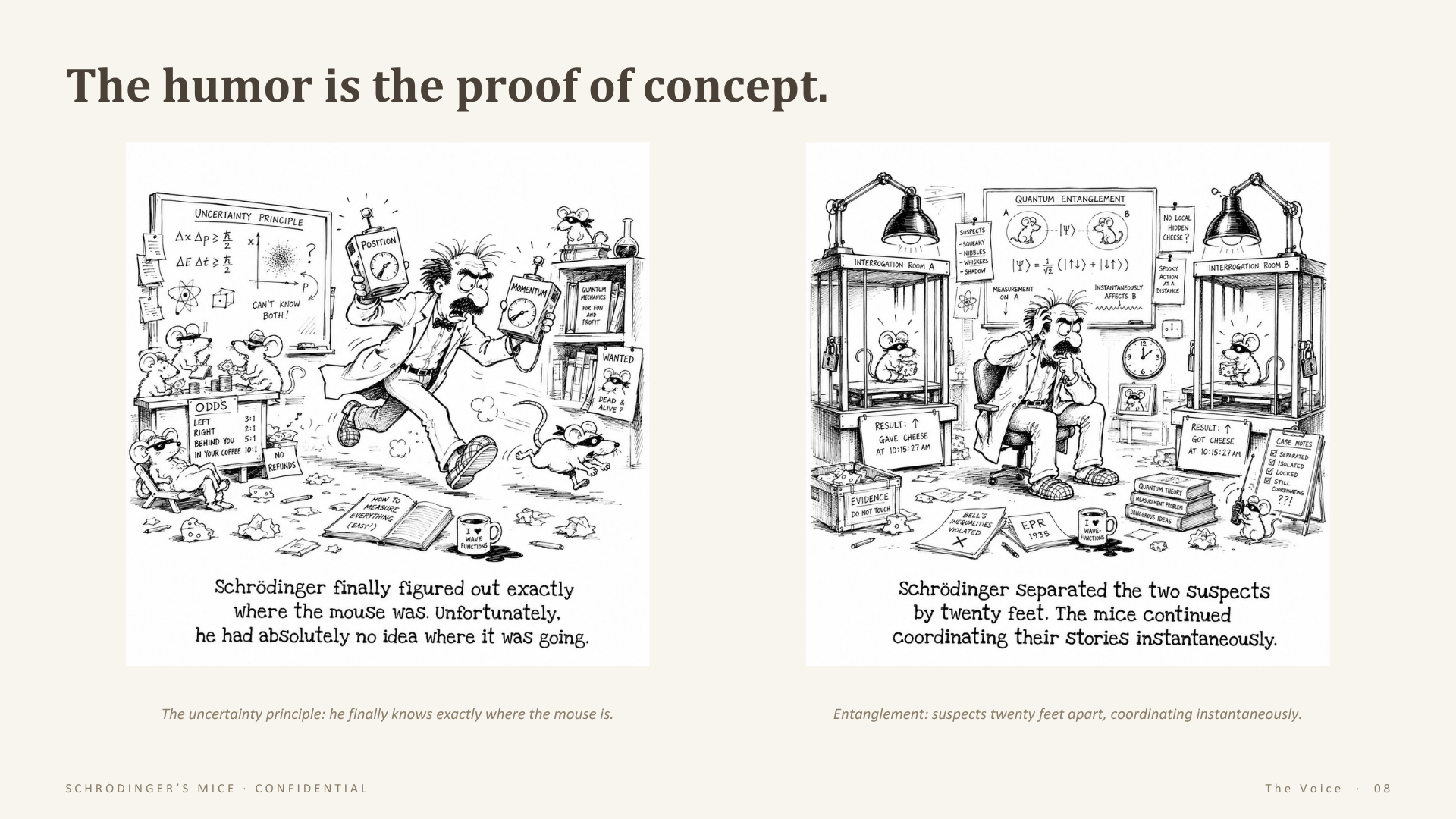
The first expression of Schrödinger’s Mice is built around single-panel comics in the tradition of Arthur Trope’s Inscrutables, with each gag using an actual scientific principle and then pushing it, as the press materials put it, “exactly one cheese too far.”
The story is being developed outward from there into a ten-short animated season. Double-slit experiments become criminal alibis. The uncertainty principle becomes a pursuit problem. Entanglement becomes coordinated testimony between suspects twenty feet apart. Tunneling, superposition, entropy, relativity, electromagnetism and chaos all eventually get their turn, building toward one escalating quantum heist.
The audience target is deliberately broad: core 8+, with visual chase comedy for younger viewers and another layer of scientific jokes for people who know enough physics to understand why the joke is technically offensive.
Or, as the press kit rather efficiently puts it: imagine Tom & Jerry meeting quantum physics, with the heart of Wallace & Gromit.
Do Not Unbox!
This is where the property started becoming especially interesting to us.
The Observation Rule is not just a story mechanic. It translates almost embarrassingly well into products.
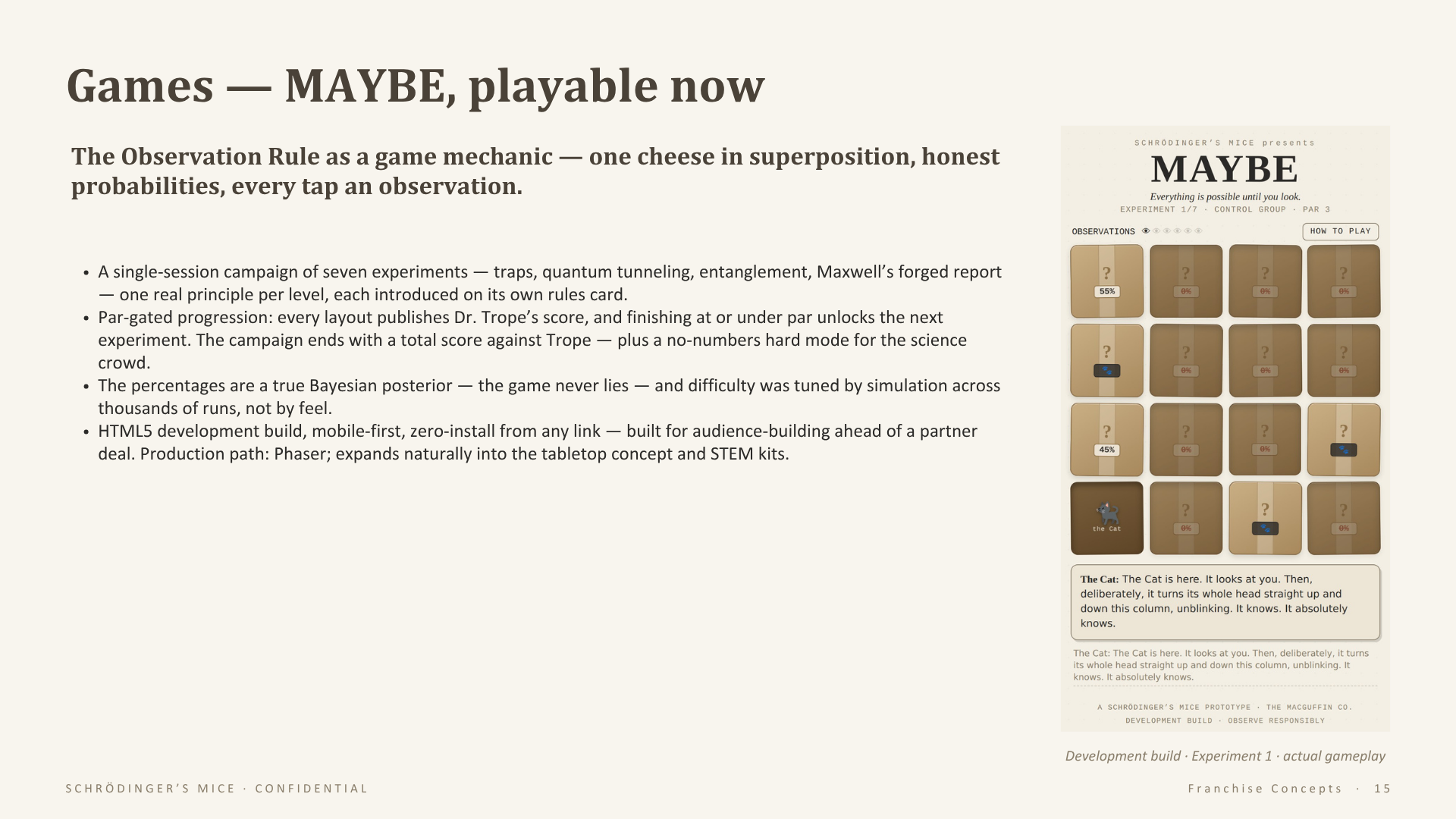
The licensing program currently spans five natural categories: mascot plush, collectible mice, lab-lifestyle merchandise, publishing and education, and games and interactive products.
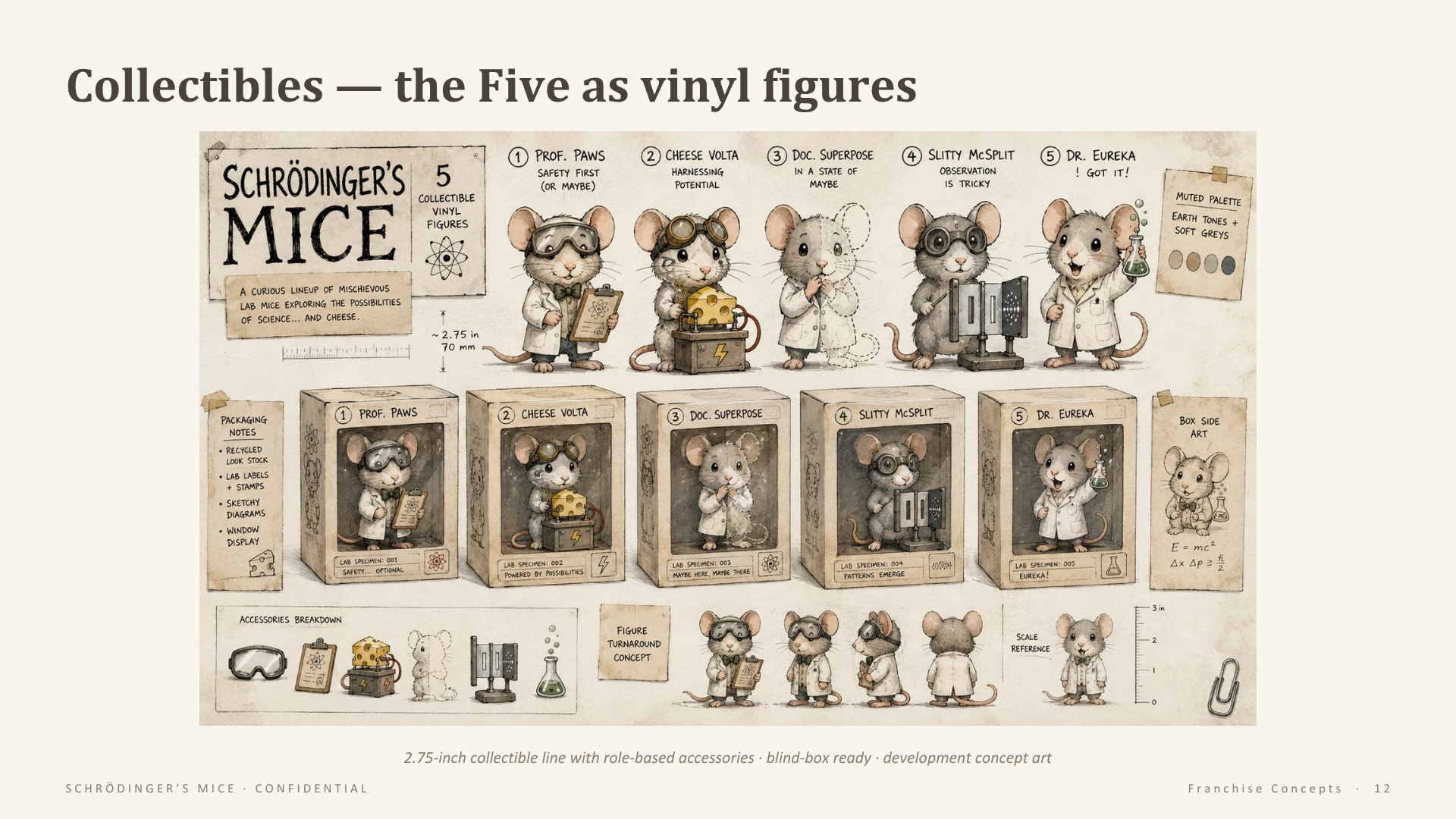
The most obvious hero product is a reversible Schrödinger’s Cat plush: one mascot, two states, packaged in the famous box so that the retail presentation is part of the joke.
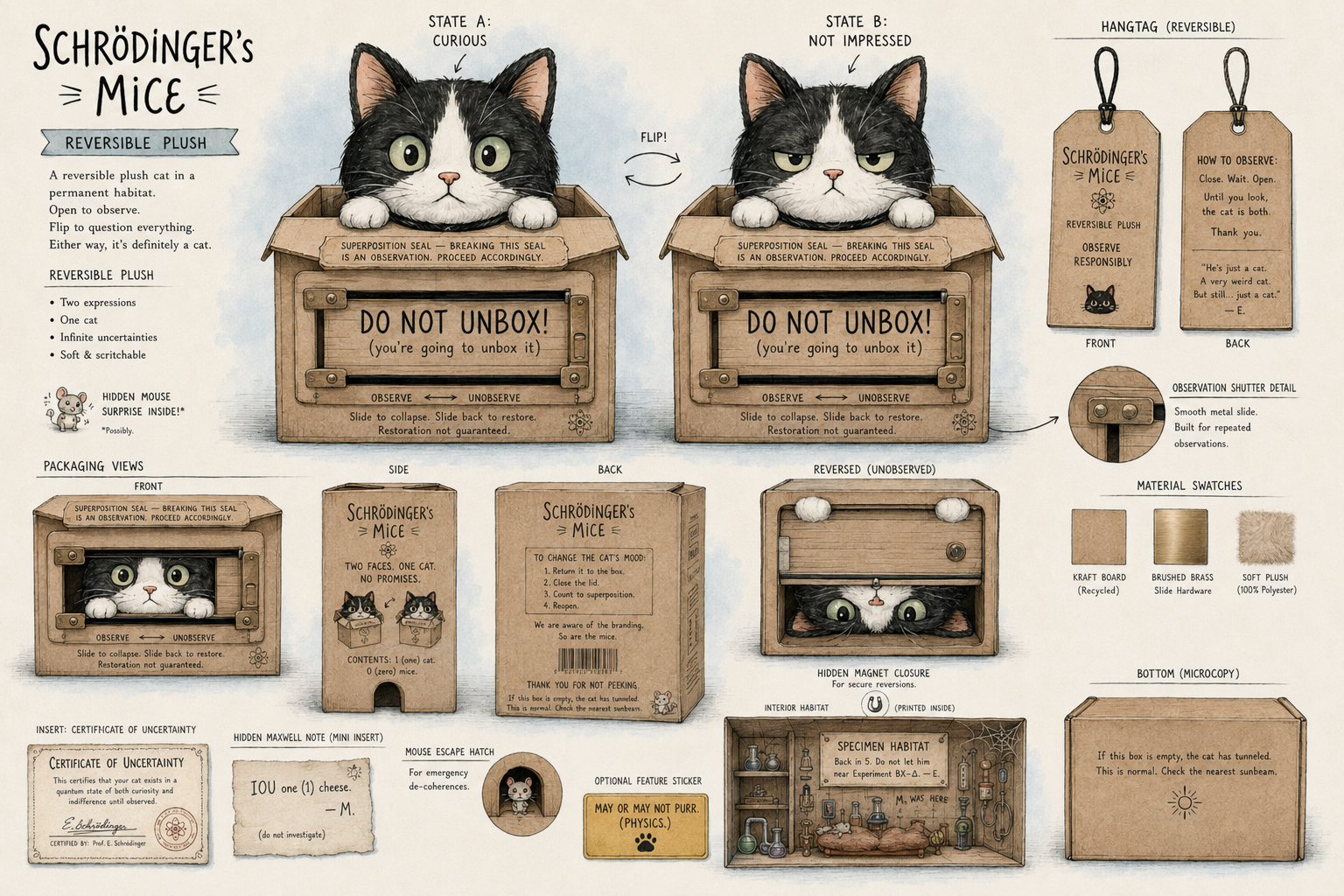
The mice are being developed as a collectible ensemble with science-based accessories and variant states. There is a lab-lifestyle line built around warning labels, notebooks, mugs, apparel and the useful instruction DO NOT OBSERVE THE MICE. There is also a tabletop concept, Cheese Heist: A Quantum Caper, in which players use Position, Momentum, Entanglement and Double Slit cards to steal cheese while avoiding the Cat.
None of this is accidental. Boxes, cheese, warning signs, equations, lab notes, tiny tools and one fundamentally unknowable cat recur naturally in the stories, which means the merchandise can feel like it came from the world, instead of feeling like a logo was printed on something during a meeting.
That seems important.
So where are we now?
The project is currently in development. A series bible, Season One episode grid, sample strips, character designs and product concept boards are already in place. The planned publishing path begins with the webcomic and moves toward a collected edition.
On the licensing side, the concept deck lays out a three-wave strategy: begin with the Cat and evergreen gift products, expand into collectible mice and retail display, then move into publishing, tabletop, STEM and puzzle formats.
We are now interested in conversations with category partners across plush, collectibles, games, publishing, apparel, gift, stationery and educational products. The project already has a series bible, character profiles, style guide, packaging system and product concept boards available for partner discussions.
And for those following Macguffin from the investment side, Schrödinger’s Mice is the kind of project our development model was built to explore: character-led IP designed from the beginning to move across storytelling formats and licensed product categories. Macguffin’s broader model develops early entertainment concepts toward books, film, games and merchandise before pursuing licensing partnerships and, where applicable, future investment offerings through the appropriate channels.
For now, no mice are being offered as securities.
Legal asked us to make that clear.
We’re looking for partners who see what we see: a simple comic rule, a strong character ensemble, real science underneath the nonsense, and a world capable of expanding into animation, publishing, games, toys and gift products without losing the joke that started it.
The mice can break the laws of physics.
Only when you’re not looking.
So naturally, we suggest keeping an eye on them.
—Ed.
Testing the Waters: No money or other consideration is being solicited, and if sent in response, will not be accepted. No offer to buy securities can be accepted and no part of the purchase price can be received until an offering statement is filed and only through an intermediary's platform. A person’s indication of interest involves no obligation or commitment of any kind.