GUFF 1: Cluemoji
“Oh child, your language is so utterly simple and limited that it has the affect of extreme complication.”
Introducing Cluemoji
There are, depending on whom you ask, somewhere between too many and vastly too many word games on the internet.
So naturally, we made another one.
From the Editor
There are, depending on whom you ask, somewhere between too many and vastly too many word games on the internet.
So naturally, we made another one.
This one started with a fairly simple question: what if the clues in a crossword weren’t words?
Not cryptic clues. Not trivia questions. Not “four-letter river in Belgium” followed by fifteen minutes of wondering whether you once knew any rivers in Belgium.
Just emojis.
🏠💯
That’s FULL HOUSE.
🧪💊
BREAKING BAD.
👻🚫
GHOSTBUSTERS.
Congratulations. You already know how to play.
Meet CLUEMOJI, the daily emoji crossword from Macguffin Co.
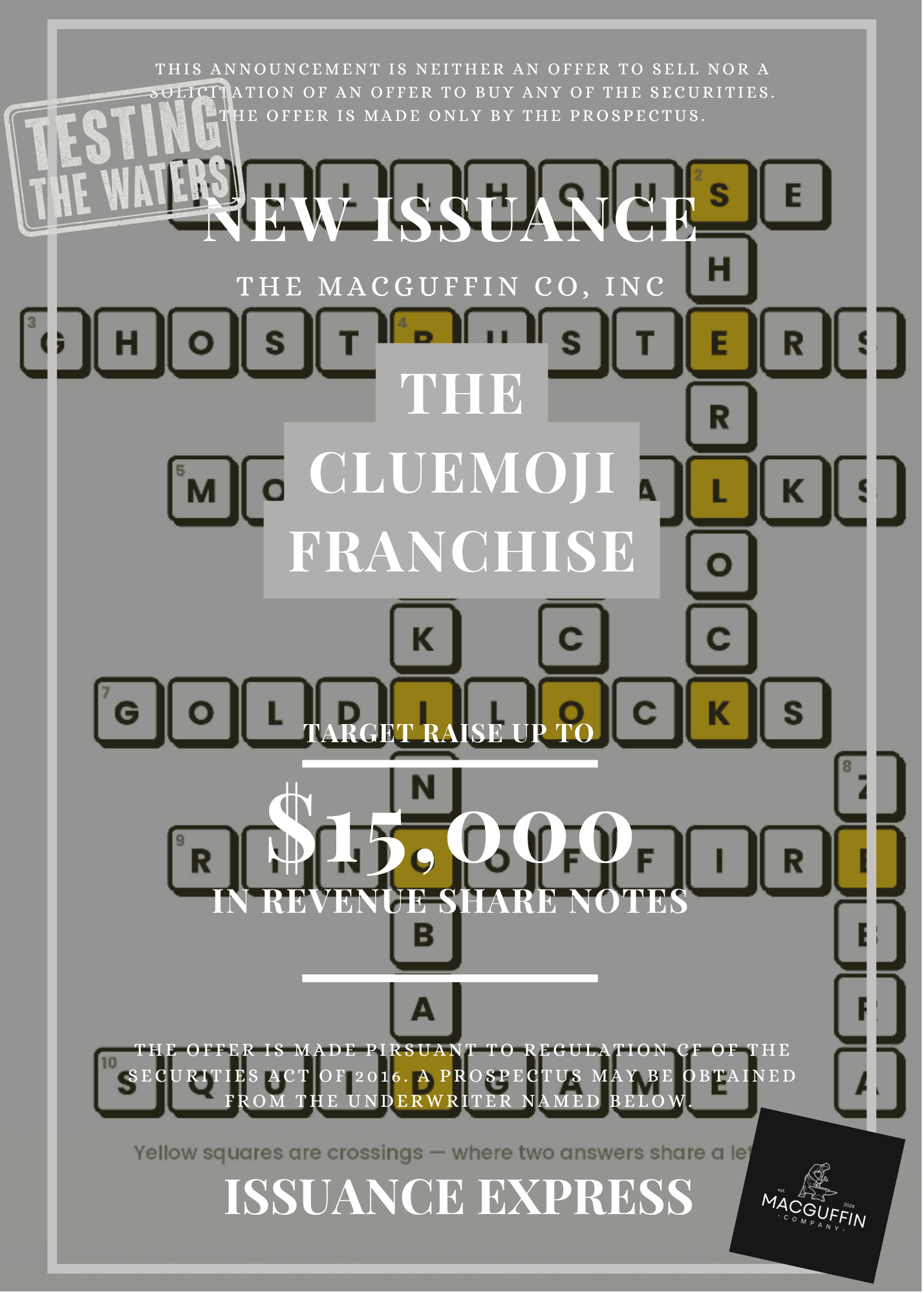
The basic mechanic is almost suspiciously simple: every clue gives you a category, a string of emojis and a word length. Decode the emojis, type the answer into a real crossword grid, and the letters you solve start feeding the clues you haven’t cracked yet.
Which is where the thing gets interesting.
The Pictures Are the Clues. The Crossword Does the Rest.
A Cluemoji daily has ten clues, Across and Down, arranged in a proper numbered crossword.
Solve one and the answer locks into place. Any letters it shares with another answer become free information. So the clue that looked completely ridiculous thirty seconds ago suddenly has a first letter, a fourth letter and an ending.
And now you get it.
That little ohhhhhhh is the game.
If you don’t get it, skip it. The grid may explain itself later. If the grid refuses to cooperate, you get three pencil hints. There’s also a timer, because apparently solving the puzzle isn’t enough; eventually someone has to establish dominance in the family group chat.
There is one puzzle per day. Everyone gets the same one.
Which means Cluemoji is less about sitting down for a three-hour crossword session and more about creating the tiny daily ritual that has turned out to be remarkably effective at making otherwise reasonable adults defend a streak counter with their lives.
The Share Button Is Part of the Game
We are particularly fond of this bit.
Finish the puzzle and Cluemoji generates a spoiler-free share showing the emojis from that day’s clues, your time and, where applicable, the shameful little pencil icon documenting that you required assistance.
The answers stay hidden.
So the thing you post to a friend is also a miniature puzzle:
What on earth did 👶🦈 have to do with today’s grid?
In other words, the player doesn’t merely share a score. The player shares an ad for the game disguised as a challenge to another player.
We’d love to claim this represents some breakthrough in advanced marketing science. Mostly we noticed that people enjoy sending each other things with the implied message I got this and I’m not convinced you will.
Cluemoji also keeps streaks and a daily leaderboard, so the usual healthy human instincts—curiosity, play, competitiveness and petty vindication—are all represented.
Our Favorite Part: The Clues Don’t Speak English
The answers do.
The clues don’t.
Emoji already function as a kind of shared visual vocabulary, which gives Cluemoji an unusual advantage for a word game: the core clue mechanic does not have to be rewritten to travel.
A Spanish edition can use Spanish answers. A Japanese edition can use Japanese answers. Local TV shows, songs, sayings and cultural references can change with the market while the fundamental mechanism stays exactly the same: category + pictures = answer.
This is a fairly important distinction.
Traditional crosswords are built out of language.
Cluemoji is built out of the little picture of the taco.
🌮
Technology is amazing.
Then We Made It Out of Paper
Naturally, once we had built a digital daily puzzle, the next question was how many other objects we could force it into.
The first answer is books.
The Cluemoji paperback format flips the daily game into a self-contained printed puzzle: decode the emoji clues on one page, match them to the crossword grid, and use the yellow crossing squares to work your way through anything that has you stumped.
The nice trick is that the solved grid is also the answer key, so the book checks itself without requiring forty pages of microscopic solutions in the back.
Volume One already has a press-ready 104-page interior, with the broader series designed as a repeatable paperback line.
And once you start looking at Cluemoji as a format rather than a single game, things get out of hand fairly quickly.
Kids editions.
Mini puzzles.
Music days.
Movie editions.
Seasonal packs.
A party game with physical emoji tiles.
A page-a-day calendar.
Custom puzzles made by players.
Classroom editions where a teacher drops in the week’s vocabulary list and the software builds the game.
Brand and entertainment packs where the sponsored material is not bolted onto the game but actually becomes part of the clue set.
Discord, Slack and WhatsApp versions where the daily standings live inside the group chat itself.
We have seven expansion tracks mapped at the moment.
This seems excessive, which at Macguffin generally means we’re getting somewhere.
Anyway, It Works.
This is the part where we would normally say the prototype is in development.
It isn’t.
Cluemoji is playable now.
The daily engine is running. The grids generate from the date. Sharing works. Streaks work. The leaderboard works. The print interior exists.
So this particular Character Issue is less:
“Here is a strange idea we found behind the sofa.”
And more:
“We built a thing. Please try to beat us at it.”
You will know within approximately one emoji clue whether Cluemoji has its hooks into you.
Here’s one to get started:
Classic TV Comedy
😃🗓️
We’ll wait.
— Ed