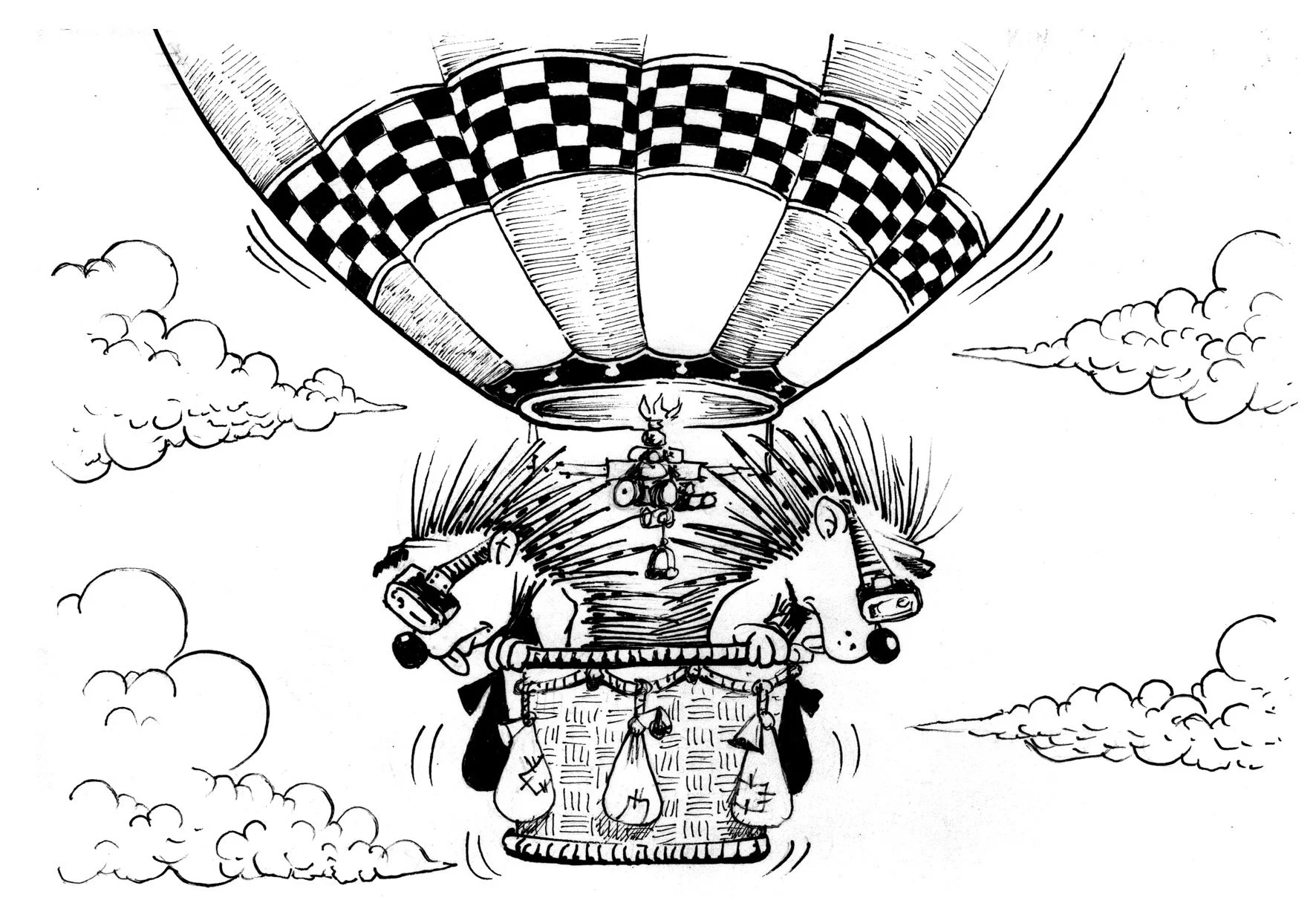
GUFF #11: Whistler
Jump To: From the Editor / Concept of the Week / Press Room / Job Board / In the Offing / In Development / Character Card / For Investors
“You ever get the feeling you’re just a porcupine in a hot air balloon?”
From the Editor
This week, we’re excited to present WHISTLER, an original romantic/comedy concept by Jenn Badua. The IP has been pre-seeded with a $10,000 creative development budget, which is being used to expand the little gem of an idea into a full feature treatment, refine character designs, animate a pilot episode, and craft a novelization.
And so we kick of the Testing the Waters campaign on Valentine’s Day, appropriately enough. With a successful TTW campaign, we anticipate launching the Investment Offering in April, with a planned raise of $25,000 - $50,000. Review the terms, assets in-development, and RSVP for the Offering, on the Whistler Offering page.
The story follows Stella Capella Cantori, an aspiring opera singer, whose pet parrot “Whistler” rockets to viral fame when he outshines her in the videos she posts to YouTube, leading her unscrupulous agent Miles Dankworth to attempt to sabotage her career in a devious effort to swindle her out of her suddenly, more-bankable, feathered friend. We are pulling the creative team together to develop a full screenplay, animated web series, and novelization for this concept.
“An aspiring opera singer, whose pet parrot rockets to viral fame, must outwit her unscrupulous agent before he sabotages her career in a devious effort to swindle her out of her suddenly, more-bankable, feathered friend.”
We’re also hiring for multiple positions to ramp up creative, so feel free to check out the Job Board if you’re interested in joining the team.
-
On November 2, 2020 the Securities and Exchange Commission (SEC) approved long-awaited rule changes to the exempt offering framework for securities regulations. These changes include significant revisions to Regulation Crowdfunding designed to expand access to capital.Regulation Crowdfunding, also known as Reg CF, is a federal securities exemption that preempts state-level securities registration. Some states still require notice filings for Reg CF offerings for businesses domiciled in that particular state or businesses that raise money from investors in that particular state. The state preemption feature of Reg CF makes capital raising less costly for small businesses and opens up more investment opportunities from contributors. Reg CF allows issuers to reach out to potential investors before commencing an offering to see how much interest there is for the issuer’s securities. This is also known as “testing the waters” and can be beneficial for gauging how successful a Reg CF offering may be.
Offerings are conducted and hosted by approved, partner funding portals, registered with the US Securities and Exchange Commission ("SEC") and members of the Financial Industry Regulatory Authority ("FINRA"), and operate as intermediaries for offerings made under Regulation 506(b), 5069c), and CF, under the Securities Act of 1933 ("Regulation CF”). Clicking on a link below will take you to the funding portal hosting the respective offering. All information on partner funding portal sites is the responsibility of the funding portal.
-
For decades, investing in movies, television, games, and other forms of entertainment intellectual property was largely the domain of major studios, private equity firms, and a small circle of industry insiders. The creative economy generated enormous cultural impact and financial returns—but everyday investors rarely had a seat at the table.
That landscape is changing. Thanks to modern crowdfunding regulations and new business models, early-stage entertainment IP has become an asset class that individual investors can finally participate in. Macguffin Co. was built specifically to make that opportunity practical, professional, and accessible.
Why Early-Stage Entertainment IP Matters
At its core, entertainment IP is the engine that powers global media. Successful franchises—whether born as books, comics, games, or original film concepts—can expand into multi-billion-dollar ecosystems of sequels, merchandise, theme parks, and digital experiences.
Investing early in the next breakout franchise offers unique potential advantages:
Asymmetric Upside: A single hit property can generate returns far beyond its initial development cost.
Portfolio Diversification: Entertainment IP performance is not directly tied to traditional financial markets.
Cultural Impact: Investors have the chance to support creative projects they genuinely believe in.
Licensing Leverage: Once an IP is developed, it can be licensed repeatedly across formats and territories.
The challenge has always been access. Developing raw ideas into market-ready properties requires capital, expertise, and industry relationships—three things that most independent creators and investors lack on their own.
The Reg CF Revolution: A Brief History
That access gap began to close with the passage of the Jumpstart Our Business Startups (JOBS) Act in 2012. Prior to the JOBS Act, U.S. securities laws made it extremely difficult for private companies to raise investment from the general public. Equity crowdfunding, as we know it today, was essentially impossible.
Title III of the JOBS Act created a new exemption called Regulation Crowdfunding (Reg CF). Implemented by the SEC in 2016 and expanded in 2021, Reg CF allows private companies to raise capital from both accredited and non-accredited investors through SEC-approved online intermediaries.
Key elements of Reg CF include:
The ability for companies to raise up to several million dollars per year from the public
Standardized disclosure and reporting requirements
Investment limits designed to protect individual investors
The use of regulated third-party funding portals or broker-dealers
For the first time, everyday investors could legally buy equity in early-stage ventures through transparent, regulated platforms. While Reg CF has been widely used by technology startups and consumer brands, its potential for entertainment IP has only recently begun to be realized.
Enter Macguffin Co.: Curating Creativity as an Investable Asset
Macguffin Co. was founded on a simple idea: great stories deserve a better path to funding, and passionate investors deserve better access to them.
Rather than asking investors to gamble on unproven creators or undeveloped ideas, Macguffin Co. acts as a professional curator and developer of franchise concepts.
Here’s how the model works:
Curation and Development
Macguffin Co. identifies promising entertainment concepts and works with writers, designers, and producers to shape them into cohesive franchise properties.Community Investment via Reg CF
These curated projects are offered to the public through Regulation Crowdfunding campaigns hosted by SEC-approved third-party intermediaries. Investors participate on equal terms with full regulatory oversight.Turning Concepts into Real Media
Capital raised is used to transform raw ideas into tangible, market-ready assets—books, film pilots, video games, proof-of-concept materials, and more.Licensing and Monetization
Once developed, Macguffin Co. pursues licensing and distribution partnerships with established multimedia companies, creating opportunities for revenue and long-term franchise growth.
This structure blends the creative instincts of a studio with the discipline of an investment vehicle—giving investors exposure to professionally managed entertainment IP rather than one-off passion projects.
Benefits for Investors
Investing through Macguffin Co.’s Reg CF offerings provides several meaningful advantages:
Access to Pre-Vetted Projects: Investors aren’t left to evaluate scripts on their own; projects are selected and developed by experienced professionals.
Regulated Transparency: Offerings are conducted through SEC-compliant intermediaries with standardized disclosures.
Shared Risk, Shared Reward: A community of investors participates together rather than any single individual bearing the full burden.
Professional Execution: Funds are used specifically to create high-quality development materials that increase licensing value.
Potential Long-Term Participation: Successful franchises can generate ongoing revenue across multiple media formats.
Benefits for Creators and the Industry
The Macguffin Co. model doesn’t just help investors—it strengthens the creative ecosystem itself.
Creators gain access to funding and development resources that might otherwise be out of reach. Studios and distributors receive more polished, market-tested properties. And audiences ultimately benefit from a wider range of original stories making it to market.
A New Era of Participation
Entertainment has always been one of the world’s most exciting industries. What’s new is who gets to participate in its growth.
By combining the democratizing power of Regulation Crowdfunding with disciplined creative development, Macguffin Co. is helping transform early-stage entertainment IP from an insiders-only game into an accessible investment opportunity.
For investors who love great stories—and want the chance to be part of the next big franchise—there has never been a more interesting time to get involved.
Investing in early-stage ventures involves risk, but with the right structure, transparency, and expertise, it can also open the door to extraordinary possibilities. Macguffin Co. aims to be that doorway.
-
This site, Macguffin.co, is a website owned and operated by The Macguffin Company. (“TMC”), which is a media franchise development company. TMC is neither a registered broker-dealer, investment advisor, nor funding portal. Nothing contained on this website should be construed as an offer to sell or a solicitation of an offer to buy any security by TMC. Any offering of securities that may be conducted in the future will be subject to terms and conditions that will be set forth in offering materials made available through one or more unaffiliated third-party websites hosted by licensed intermediaries/funding portals registered with the US Securities and Exchange Commission ("SEC") and members of the Financial Industry Regulatory Authority ("FINRA"). TMC does not provide any investment advice or recommendations and do not provide any legal or tax advice concerning any Offerings. By accessing this site and any pages on this site, you agree to be bound by our Terms of Use and Privacy Policy as may be amended from time to time without notice.
Character Cards





Press Room



Coming Soon




Concepts in Development




The Periodic Inscrutable

Arthur Trope
Don’t know about you, but I’m in need of a weekend. After prepping the entire canon for next week’s S-MCSS2 run, not to mention the debacle on Thurs, I’m due. Speaking of, I came across a bunch of non-canon material in the prepping this week. This one’s based on an abstract painting Artie did years ago called “Two Fish Pedaling a Tandem Bicycle in Opposite Directions”. Which is a pretty straightforward title now, but you should’ve seen the abstract. I’ll see if I can track down an image & run a side-by-side. I recall seeing it in a catalog once from the Tate Modern. Artie was painting a little in SF in the 80’s and he was connected in the LA art scene & a guy named Gagosian, who owns some galleries, got interested in his work & gave him a show. David Bowie bought 2 of his pieces, including the fish abstract & Artie ended up w an invite to hang a group of charcoal sketches at the Tate in London, next to a David Hockney exhibit. Technically it was next to the men’s room, over the water fountain, around the corner from Hockney. But it was the next collection you saw when you rounded the corner, if you were headed to the loo. Anyway, the painting doesn’t look at all like two fish on a tandem bicycle. It looks like a bad photocopy of a Rorschach test. The Times wrote a review & drew connections to Gloria Steinem & wondered whether it was a statement on feminism or anti-feminism. The Guardian said the collection “reached new heights in navel-gazing - except for the Hockneys, which are sublime”. But Artie was always fond of the piece, esp the title, & at some point he sketched this more literal version of 2 actual fish actually pedaling a tandem bike in opposite directions. He made it his personal logo, which means it’s on his business cards and he printed some t-shirts. He refers to it as his “family crest”. He titled the sketch ‘New Heights in Navel-Gazing’ bc now the old title doesn’t work bc it’s too literal. When Bowie passed away, Artie inquired about buying the painting back from his estate, but no one on the Bowie side knew anything about it. I suppose if, when we die, our souls turn out to be just single-panel comics, this’ll be Artie’s. -Ed.