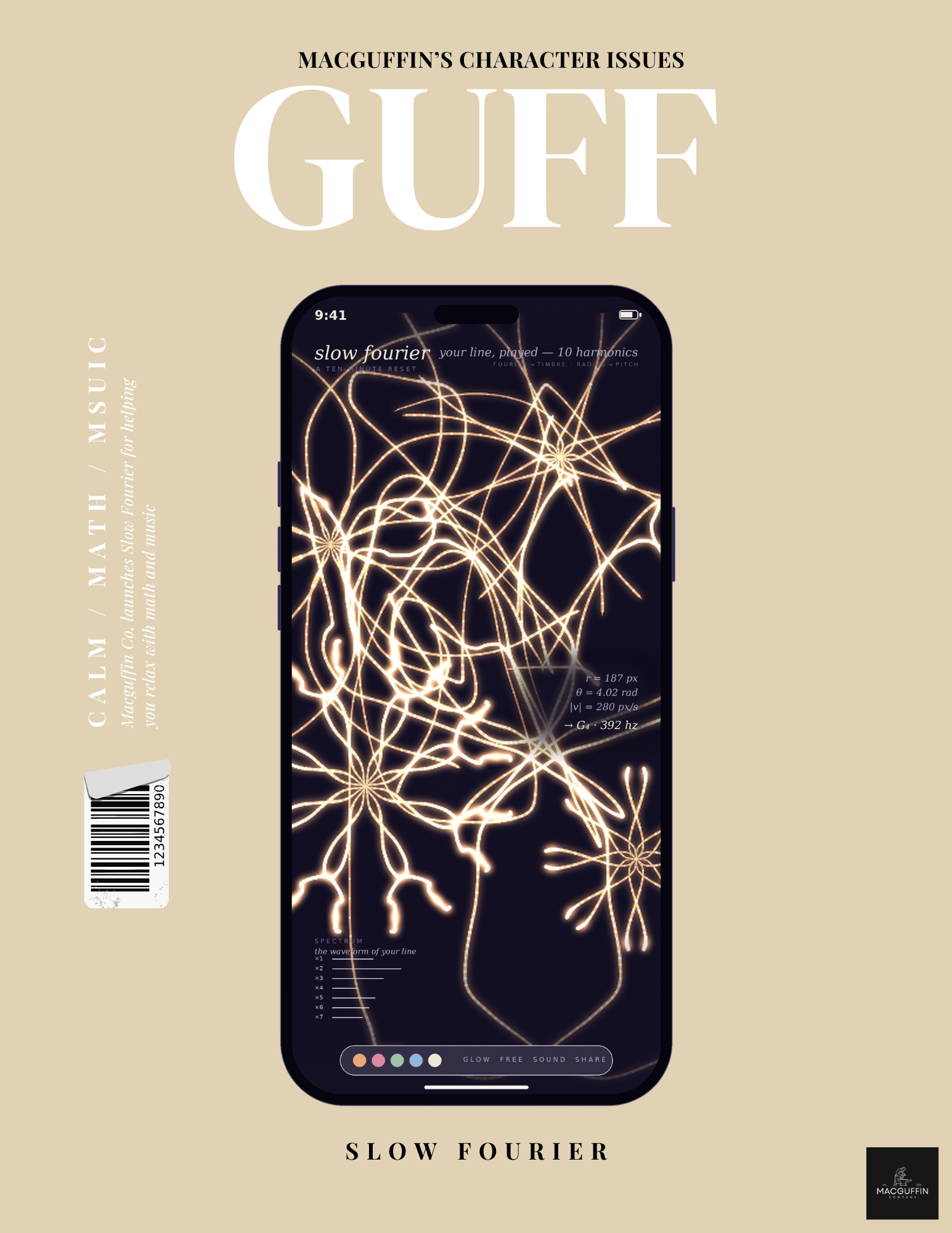
GUFF 4: Slow Fourier
“Keep calm and do math.”
Introducing Slow Fourier
For roughly two hundred years, mathematicians, engineers and computer scientists have been trying to make the Fourier transform faster.
We made it slower.
Macguffin Co. is introducing Slow Fourier, a new interactive drawing instrument built around a fairly peculiar proposition: maybe mathematics does not always need to be something you solve. Maybe sometimes it can just sit there, pay attention to what your hand is doing, and make a pleasant noise.
Slow Fourier is live now. It takes about ten minutes. There is no score. You cannot win. This may damage its prospects as a mobile game, but we’re willing to take the risk.
Draw something. It sings.
The experience begins with one button: settle. No account. No tutorial carousel. No demand to choose whether you are using the product for Personal Growth, Improved Focus, Better Sleep, Corporate Synergy or because Instagram somehow convinced you that magnesium is a personality.
You press the button and draw.
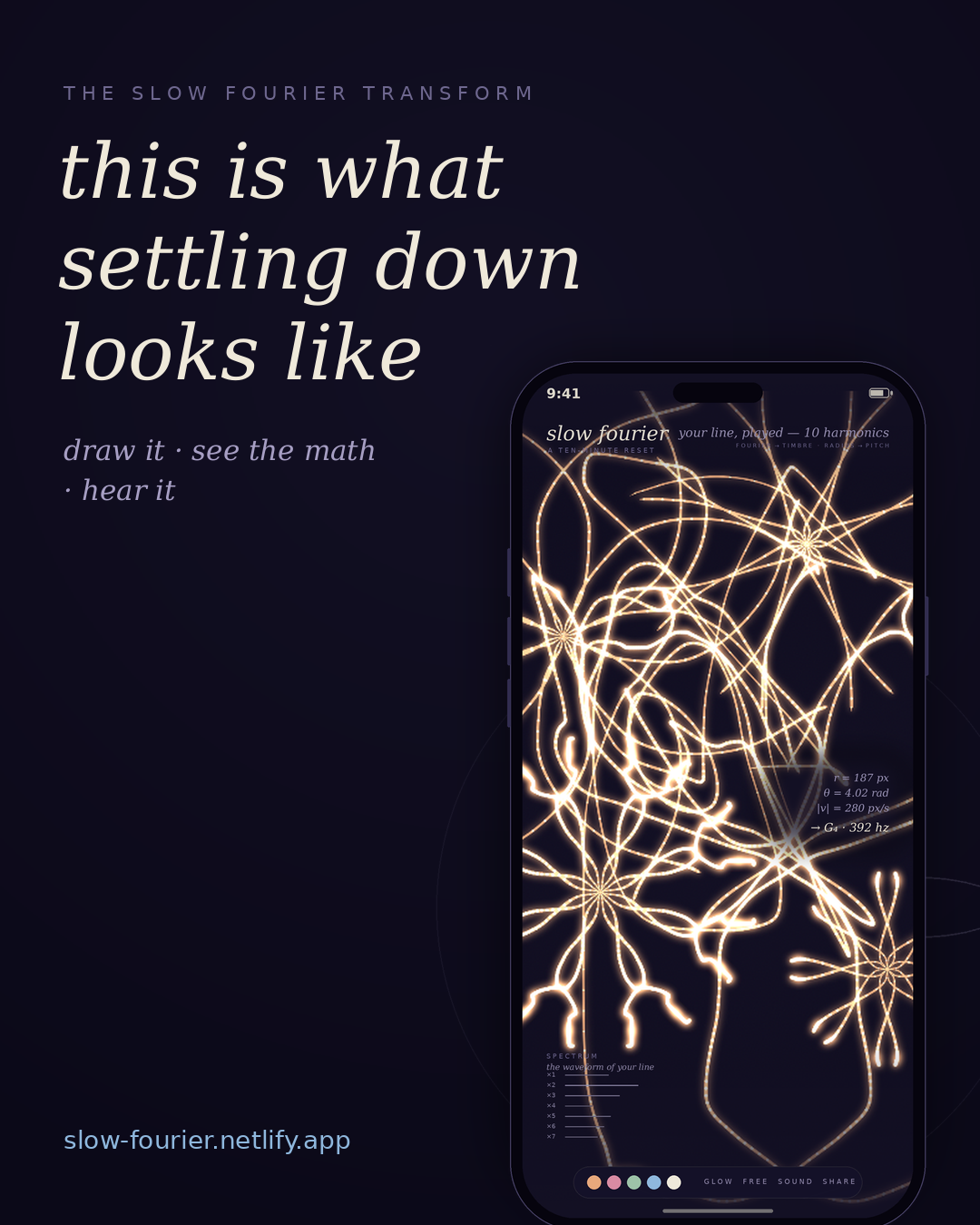
Your line is repeated through symmetry, so even a distracted squiggle begins looking suspiciously intentional. As your hand moves, its distance from the center becomes pitch. Your line literally sings while you make it.
Then you stop.
And this is where the thing gets interesting.
A chain of circles appears and begins retracing the line you just drew. Those circles are not a visual effect added by an ambitious designer. They are the Fourier series of the gesture itself.
At the same time, the app turns that same mathematical information into sound.
Which means you are looking at your drawing and listening to your drawing through two different representations of the same mathematics.
A smooth oval produces something close to a pure tone.
A jagged star produces a brighter, more complicated sound.
Or, put another way:
A circle is a sine wave, heard.
We admit this is a strange product.
We also think that’s the point.
The opposite of being graded
There’s another idea underneath Slow Fourier that has less to do with mathematics and more to do with the unfortunate things adults do to perfectly good crayons.
Most people draw enthusiastically as children. Then drawing becomes something that can be judged.
Are you good at it?
Does the horse look like a horse?
Why does Grandma have six fingers?
And somewhere around there, a lot of people stop.
Slow Fourier deliberately removes the evaluation.
There are no scores, streaks, likes, rankings or leaderboards. There isn’t even an undo button.
Instead, the app describes what you did.
You drew this many meters of line.
Your hand turned through this many radians.
Your stroke contained this many harmonics.
That’s it.
The math notices.
It does not have an opinion.
Eventually you press release, and the drawing dissolves like a sand mandala.
Which is a surprisingly satisfying way to dispose of ten minutes of work, and considerably cheaper than renting a storage unit for every piece of art you have ever made.
Math people apparently needed a fidget spinner
Slow Fourier lives in a useful little gap between several audiences that already exist but don’t generally meet in the same product.
There is the enormous online audience that watches Fourier series, geometry and mathematical visualizations recreationally.
There are people who use drawing, doodling, ambient music and repetitive motion to decompress.
There is the broader “slow” culture around food, television, music and intentional rituals.
And there are engineers, programmers, analysts and assorted people who already know what the Fast Fourier Transformis, which means the name “Slow Fourier Transform” makes them groan almost immediately.
Excellent.
Those are our people.
Most products aimed at the math-curious are educational: watch this explanation, solve this problem, learn this theorem.
Most products aimed at relaxation are consumptive: listen to this voice, watch this animation, breathe when instructed.
Slow Fourier asks you to make the thing yourself.
Not particularly well.
Just slowly.
The share button contains approximately no social network
This is probably the part that interests us most at Macguffin.
Because Slow Fourier has been designed not only as an experience, but as something that can travel.
When you finish a session, the app can generate a little text card containing a Braille-dot rendering of the drawing, its harmonic spectrum and a few statistics about the gesture.
It looks cryptic.
That is intentional.
The useful question on the internet is often not “Do I understand this?” but:
“What is that?”
And unlike most share cards, this one is text. No image upload. No server-generated preview required. No moderation system needed to determine whether somebody has drawn something anatomically ambitious.
More interesting still, when somebody shares the actual Slow Fourier experience, the link does not point to a stored drawing.
The link is the drawing.
Or more precisely, the link contains the Fourier coefficients needed to reconstruct it.
A friend taps it.
Their phone recreates the line.
Their phone recreates the sound.
Then the instrument hands them the pen.
There is no account connecting the two people. No database of drawings sitting somewhere waiting to be breached. No giant cloud bill quietly developing an appetite.
The math travels instead.
We like that.
Why investors should pay attention
Slow Fourier is not interesting to us because somebody has invented another wellness app.
There are sufficient wellness apps.
It is interesting because it has the beginnings of a media format.
The visual output is inherently filmable: glowing symmetric drawings, epicycles reconstructing a gesture, rose curves appearing while the user rests, finished work dissolving into particles.
The output is abstract geometry, which makes it unusually clean from a brand and moderation standpoint.
The experience runs largely on the user’s own device.
And, most importantly, the product has a natural ritual loop.
That last part matters.
Media companies have spent the better part of the internet era attempting to manufacture habits with notifications, infinite feeds, recommendation engines and increasingly desperate subject lines.
Occasionally somebody discovers that you can also make something people simply want to do once a day.
Our proposed next experiment is called Today’s Curve.
One curve.
Once a day.
Everybody begins with the same mathematical seed and produces their own interpretation. Sessions become comparable without becoming competitive. The resulting cards become recognizable without becoming identical.
The simplest version could be piloted in a week.
From there, the format can expand: embeddable versions inside articles, limited visual and musical “seasons,” collaborations with composers or observatories, and editorial pieces that unpack the mathematics behind what people have just experienced.
In other words, Slow Fourier can be an app.
But it can also be a recurring editorial property, an interactive feature, a sponsor-friendly format and a piece of participatory media.
That is the part we intend to explore.
Small product. Interesting surface area.
The current Slow Fourier build is deliberately slight.
One HTML file.
Canvas graphics.
Web Audio.
On-device synthesis.
No giant technology stack sitting behind a loading spinner insisting that you accept seventeen categories of cookies before you can draw a circle.
That means the next questions are not primarily engineering questions.
They are audience questions.
Do people finish a session?
Do they come back?
Do they share the strange little card?
When somebody receives one, do they tap it?
And after their phone reconstructs another person’s drawing and plays it back to them, do they make one of their own?
Those are useful things to test because they tell us whether Slow Fourier is simply a lovely object — which would be fine — or the beginning of a repeatable media behavior.
So that’s what comes next.
For Investors
We are introducing Slow Fourier to the Macguffin community at the pilot stage, not announcing an investment offering.
The immediate proposal is deliberately small: put Today’s Curve in front of a real audience for one week and watch what happens.
We bring the instrument, mathematics and sharing loop.
A media partner brings an audience and a daily drumbeat.
Then we measure the things that actually matter to this experiment: completed sessions and shares.
There are no investment terms being announced here, and nothing in this post is an offer to sell or solicitation to purchase a security.
For now, consider this what Macguffins are supposed to get before spreadsheets become involved:
the interesting bit at the beginning.
A small idea.
A working prototype.
A peculiar audience.
And enough evidence of a repeatable behavior to make us curious about what it might become.
Go draw a line.
We’ll see what the circles have to say.
— Ed